Showing posts with label piracy. Show all posts

Tuesday, February 7, 2012

Spanish Publisher Guild Misleads on Ebook Piracy

Nota: Se puede encontrar una traducción al castellano de este artículo en Canal PDA.

Update: The Spanish Publisher Guild corrected their report this morning.

It was not my intention to find errors in the Spanish Publishers' Guild recent report on reading practices in Spain during the #edigital chat this morning (held Tuesdays, 16h CET, 11am EST, 7am PT). But there on the front page was this assertion:
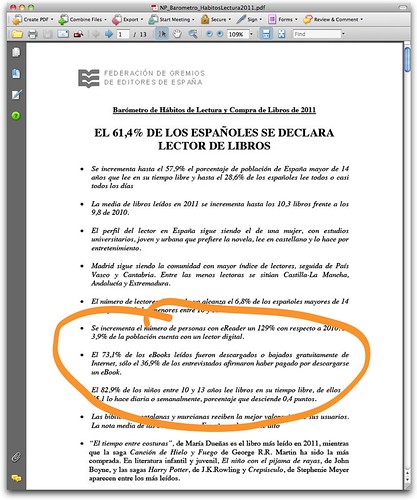
NP_Barometro_HabitosLectura2011.pdf“73% of the ebooks read were downloaded or downloaded for free from the Internet, only 36.9% of those polled said they had payed to download an ebook.”

So, I dug inside and found this, worded very similarly:


This one says, “One significant datapoint is the way in which digital readers obtain their electronic books (ebooks). 73.1% of the books were downloaded or downloaded for free from the internet; 37.3% got them from family members or friends, via usb, cd or mail; and another 36.9% downloaded them or downloaded them from the Internet by paying for them.”

The first thing I noticed was that 73.1% + 37.3% + 36.9% does not equal 100%. Something's not right.

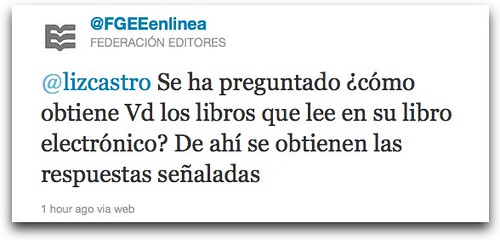
So I asked the Guild where the numbers came from, and they said the question asked was:
Twitter / @FGEEenlinea: @lizcastro Se ha preguntad ...

“We asked “How do you obtain the books that you read in your electronic book [sic, perhaps they meant reader?]' From there we got the reported results

In other words, 73% of the ebooks read in Spain were not downloaded for free. That's a completely erroneous and faulty conclusion, stated twice in their report.

Instead, the truth is this: 73.1% of those polled said they had downloaded ebooks for free, 37.3% reported they had gotten ebooks from a family member or friend, and 36.9% had purchased ebooks for download. We don't know if other people polled obtained their books by other means.

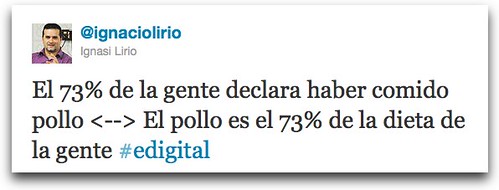
As Ignacio Lirio pointed out, there's a big difference:
Twitter / @ignaciolirio: El 73% de la gente declara ...

“73% declare they've eaten chicken <--> Chicken is 73% of the diet of the people”

Frankly, I'm surprised the number is not higher. Who, among ebook readers, has not downloaded a book for free? Gutenberg has 38,000 of them. I've certainly downloaded several myself.

I find this manipulation of data really unconscionable and asked the Guild to correct their report:

Twitter / @lizcastro: .@FGEEenlinea Creo que ten ...

“I believe you have the duty to correct the erroneous conclusions reached on the cover of your report”

To date, I have had no response. I also asked for a comment for this article, but none arrived.

And why does the Spanish Publishers Guild want you to think that Spain is teeming with ebook pirates? I honestly don't know. Your thoughts welcome.


Update:

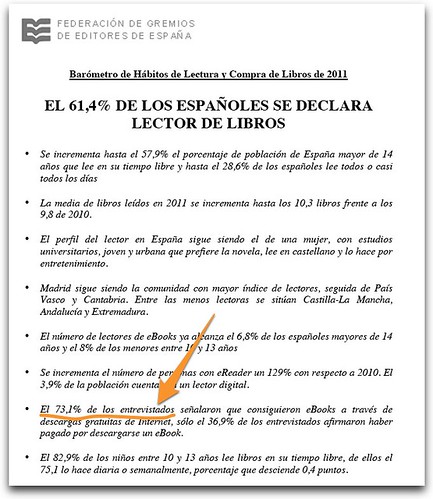
The FGEE fixed their report this morning, with nary a tweet. Nor did they rename the link or the document. I found out from someone who tweeted a French report about this post.
NP_Barometro_HabitosLectura2011(1).pdf

So, now that we can look at the numbers, what do they tell us about the way people in Spain get books, both print and electronic?

First, lets talk about the already familiar numbers: 73% of responders have downloaded books for free from Internet, 37% have gotten them from friends and relatives, and 37% have bought them. Since people obviously get books from various sources, they could check multiple answers, and thus the numbers don't add up to 100%.

And then we see something very interesting: 37% of ebook readers buy electronic books compared with 43% of those polled who said they had bought non-textbook print books. Those numbers are not that different. If we don't assume that 57% of the non print book buyers are thieves, why would we assume that of the non-ebook buyers?

And then look at this. 28.5% of those polled visited a library. (This is very low compared with the US, where the number is about 75%.). When you look at young people between 14 and 24, the number climbs to 60% who go to the library, for free! The poll does not explain how many people borrow books from their friends, but I suspect it's also a sizable amount.

Like Mark Twain said, “There are three kinds of lies: lies, damn lies, and statistics.”

Wednesday, November 9, 2011

Organic Farming and Ebook Piracy

Yesterday in my car I was listening to a recent episode of this excellent Catalan radio show about technology (and “what people do with technology”), l'Internauta, hosted by Vicent Partal. The filmmaker, Anna Boluda, was co-host, and the special guest was Simona Levi who was talking about "free culture" and lots of other interesting things

At 37:09, Vicent said something that really caught my ear (my translation, original at end of post):
Two things that I always put on the table and that at Vilaweb [Vicent's news portal] we are always thinking about and working on: the first is sufficiency, that is, you don't have to earn that much money, you just have to earn enough, no? I mean, is it possible to imagine a model in which, for example, in our case, those who are really interested and care about Vilaweb pay for it, and for those for whom it's just another website, well, thanks for reading. You don't have to make everyone pay, you can find a mass of people that is enough for you and you don't necessarily need everyone to pay you.
The second thing, said the other way around, is sustainability, that is, you have to know what you need to keep yourself financed and you have to act from that base of sustainability for your own project. In my opinion, that comes naturally and doesn't need complicated algorithms or arguments, it's just that there's a certain equilibrium, no? between the people who say I'll pay [and those who won't] and if the ones that are willing to pay are enough, well, you don't have to force the machine and turn yourself into a huge global power, I don't know, I see it as one of the keys, and of course, the only problem is that sufficiency ends up depending on each person, for one person it's enough to have a house, and for the next guy only a three masted yacht will do...
And it made me think about something I read in one of Barbara Kingsolver's books, maybe it was Prodigal Summer. It doesn't really matter where it came from; it's a common tenet of organic farming... that you have to plan to make a big enough crop so that losing some of it to "pests" isn't the end of the world. And not only that, if you spray pesticide over your crops to kill the bad bugs, you inevitably kill lots of beneficial bugs as well.

What are the beneficial bugs in the ebook ecosystem? They are your loyal readers who want to read your book and then will talk about it with other people so that they want to read your book too. When you tie your ebook up with DRM, you make it a hassle not just for pirates (who, like corn borers, just evolve to beat you another day) but for the folks who would buy your books and promote them to your friends.


You can find the recording at Vilaweb. Here's my rather wobbly transcript of Vicent's Valencian Catalan:
Dues claus que jo sempre poso sobre la taula i que també a Vilaweb estem d'alguna manera amb +Vilaweb pensant i treballant sobre tots aquests conceptes: un el de suficiència, és a dir, no cal guanyar tants diners, cal guanyar els justos, no? és a dir, és necessari, podem plantejar un model en el qual per exemple en el nostre cas, plantegem un model, a qui realment li interessi i li importi Vilaweb que ajudi pagant, però a qui som un més, gràcies per llegir-nos, no cal, per tant, no cal obligar a tothom a pagar, tu pots pagar un nucli de gent que és suficient per a tu ja i no necessites que et pagui tothom per dir-ho d'alguna forma i el segon que és girat al revés el de sostenibilitat és a dir, tu també has de saber el que necessites per finançar-te i per tant actuar sempre des d'aquesta base de la sostenibilitat del teu propi projecte. Per mi hi hauria una especie de diàleg molt difícil de fer segurament però a la vegada molt, tinc la sensació que molt natural, que naix de forma espontànea, que no requereix ni grans algoritmes ni grans discusions que és com un cert equilibri no? natural entre la gent que diu no, jo pague i aquells que diuen jo pague si ja són prou, no cal forçar la màquina per a convertir-te en un potentat, no, no sé, jo ho veig com una de les claus i clar, això, diguem, el defecte que pot tenir és que la suficiència al final acaba depenent de cadascú, per algú és suficient tenir una casa i per algú per ser suficient necesita un veler de tres pals...


More of my books