Showing posts with label twitter. Show all posts

Thursday, March 19, 2015

Meerkat testing - streaming video on Twitter

I tried tweeting some vines (very short, sometimes edited videos) a few weeks ago during the Sant Medir festival here in my Barcelona neighborhood of Gràcia and really liked the idea of capturing an event with video and not just photos.

Today, I tested Meerkat, which everybody has been talking about since it's debut (ish) at SXSW.

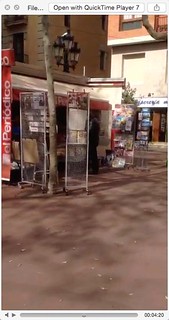
I went to a lovely little square in Gràcia, in the middle of Barcelona to do a test. A few things I learned:

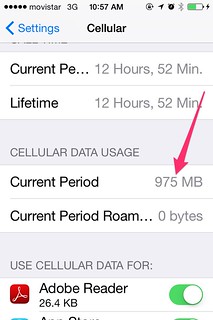
1. It doesn't use as much data as you might think. My 8 minute video was broadcast using only 25Mb of data from my 3G network (you can test this by going to Settings > Cellular > and then checking the figures at Cellular Data Usage for the Current Period before and after you meerkat). I got a couple of "low bandwidth" warnings, but these are not reflected in the final video. I asked the people watching, and they told me that they didn't notice a lag.

Cellular_Before Cellular_after

2. You can see tweets from people who are watching your meerkat stream as you broadcast, and you can answer, but those tweets are not saved when you save the video later. Further, all of your tweets are sent to your own Twitter timeline prefaced with your user name (why?), but they don't reference the meerkat stream (why not!?) so anybody looking at your Twitter stream who hasn't seen the initial | LIVE NOW | notice just thinks you're talking to yourself.

Pantallasso d'un vídeo de Meerkat

3. Instead of tweet commentary, it's better to add audio (thanks Patrick Jackson!). I had my headphones so the microphone was close by. Then I could explain what I was streaming and answer questions from people who were watching.


4. Once you've stopped broadcasting, Meerkat gives you the option of saving your video. The first time I tried, it gave me an error, but it let me try again, and then it saved. Remember that any tweets that accompanied the video are not saved. It would be nice to have the option. The 8 minute video takes up 31Mb. (It may be that that's the same amount of data that was used, Settings doesn't give exact figures.) Quality is very reasonable.

5. Patrick tells me you can only stream vertical video and that if you rotate the phone, you simply lose 2/3 of the screen. That's too bad. (I didn't try it.)

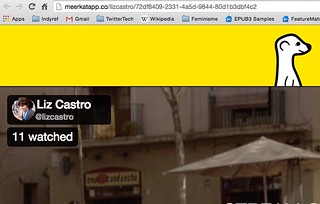
6. You don't have to have Meerkat installed in order to watch video. Of course, you do need the program (available currently only for iOS) to add tweet comments (which is only visible while it's being broadcast) or to stream your own productions. Once the broadcast is over, Meerkat does not give a lot of information about what was shown, or where you might find the video (since it is not saved anywhere except on the broadcaster's phone, if they've chosen to save it). It does tell you how many people watched. In my case, for this first meerkat, there were 11 people watching, including Patrick and some other journalists I was talking to just before the test. I couldn't figure out a way to see who those 11 were, or to follow them back. This clearly very new software.

Post-emissió

7. Wow, there are so many possibilities. As Patrick says, there are three upcoming elections in Barcelona, the city elections (which may be a bellwether for the Parliamentary turned plebescite elections for independence in September) and then the Spanish general elections later in the fall, in which many pro-independence supporters are promoting either a total boycott, or going enmasse to demand recognition of the previous independence vote. And there are always protests, and speeches, and cassolades…

Not to mention all of the cultural events, or concerts... Hmmmm.

Questions to be answered:

1. What are the legal ramifications? Do same legal rules apply about livestreaming bystanders as when photographing them?

2. How can you get more people to be involved, watching, commenting?

3. What happens if a lot of people try to meerkat the same event? How quickly before bandwidth gets jammed?

I'm sure there are many more. What do you want to know? How would you use this software? What would you like to see streamed from Barcelona?

Friday, March 6, 2015

Customizing a Twitter feed widget

I haven't posted here in way too long, partly because the blog had veered so far toward e-book publishing that I worried that posting about anything else was distracting. I think I just worry too much. Today I return to this blog about "pigs" (local food, buying local, etc.), "gourds" (creating beautiful things, by hand or by bits), and "wikis" (technology, ebooks, twitter, publishing, etc.) I hope you enjoy what I share here.

This post comes from a Twitter workshop series that I've been doing in Catalan over at Dra. Piula. I mean to translate it into English, but for now I may just do highlights. We'll see. But I thought this post about customizing a Twitter feed widget would interest a lot of English speakers as well. Here goes:

-----

You may already know how to create a Twitter widget for your blog or WordPress. It's not hard. You go to Settings in Twitter, click Widgets on the left, Create New on the right, and then choose criteria for the contents of the Twitter feed. Then click Create, and copy the code to your blog.

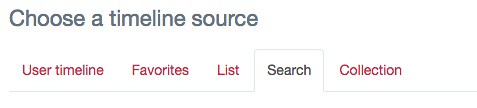
But how can you go beyond Twitter's basic search options? At first glance, it looks like you have to choose between a User timeline OR Favorites OR a List OR Search OR a Collection:

timeline_source

But what do you do if you want a user's timeline with a certain hashtag? What if you only want to someone's tweets in English? :) Or you want to see all of the tweets of a group, but only regarding a particular topic?

I'll show you.

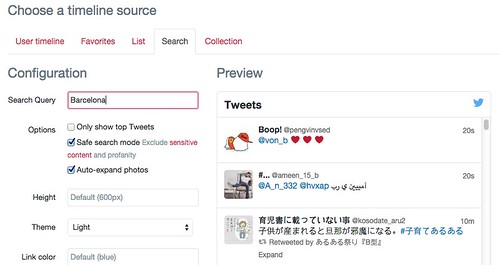
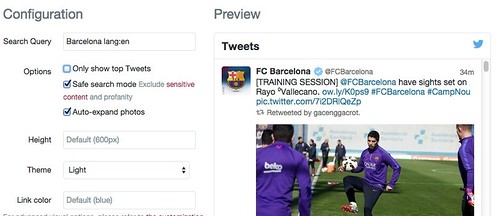
To begin, make a normal widget using the Search option and enter the first topic that interests you into the Search Query box:

Search1

Notice that the Preview populates with all of the tweets that satisfy that criteria, which I can promise for Barcelona, means a lot of varied tweets.

Let's search only for tweets in English. Use lang:en (the two letter language code for English. And note that ca is for Catalan, but it doesn't work).

Search2

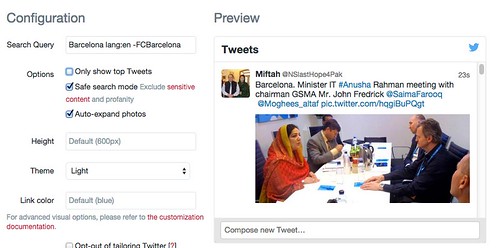
Now let's get rid of tweets that mention FCBarcelona, as much as we may love them, since they tend to block everything else out about Barcelona. Use -FCBarcelona

Search3

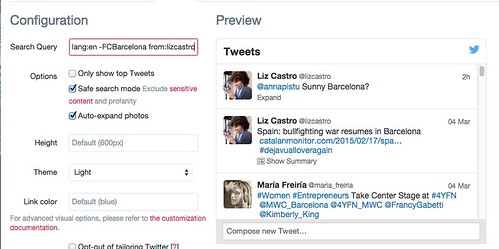
How about only tweets (and retweets) by me? Use from:lizcastro

Search4

The possibilities are endless. You can precisely tailor your Twitter feed gadget to your audience, without having to limit your activity on Twitter itself.

What other criteria can we use for a search? Here's all the ones I found:
  • To search for a given word or hashtag, just list it: Barcelona, #MWC15, etc.
  • To exclude criteria from the search, use a minus sign: -beach or -from:troll
  • To find tweets in only a given language, use lang followed by the two letter code for the desired language: lang:en or lang:fr. Unfortunately, Twitter doesn't know how to distinguish tweets that are in Catalan, sometimes it thinks they're Portuguese, sometimes Romanian, sometimes Italian. And if I tell it to show me only Catalan tweets, it doesn't show any at all :( 
  • By default, RTs are included. If you don't want them, add exclude:nativeretweets
  • If you want only tweets that contain images, use filter:images
  • If you want only tweets that contain videos, use filter:videos
  • If you want only tweets that contain vines, use filter:vines
  • If you want tweets with links, use filter:links
  • If you want tweets from a given Twitter account, use from:TwitterName (no @ needed)
  • If you want only tweets from verified Twitter accounts, use filter:verified
  • If you want tweets only from the accounts belonging to a given list, use list:list owner name/list name
  • If you want only tweets who have received a given number of replies, use min_replies:n, where n is that number 
  • If you want only tweets with a certain number of favorites, type min_faves:n, where n is that number 
  • If you want only tweets with a certain number of RTs, use min_retweets:n, where n is that number
You can use AND, OR and parentheses to combine criteria:
  • If you separate each criteria with a space, Twitter concludes that you want only tweets that satisfy all the criteria. As if you typed an AND between them. So Catalan independence will get you tweets that include both Catalan and independence.
  • If you separate each criteria with an OR, Twitter will show you tweets that satisfy either one criteria or the other.
  • If you want to exclude a criteria, use the minus sign (equivalent to NOT).
  • You can use parentheses to combine criteria in various ways (Catalan OR independence) lang:en would get you all tweets in English that talk about either Catalan or the independence (so you might get Catalan books or Scottish independence, for example).
Are you thinking about all the possibilities?
  • Combine from:username and min_retweets:100 to get only the user's most popular tweets
  • Combine from:username and lang:en to get only a user's tweets in a given language
  • Combine from:username and -lang:en to get only a user's tweets that are not in English
  • Combine from:username with a search term to see only the user's tweets that are about a given topic
  • Combine list:listowner/listname and -from:username to get all of the tweets from a list, except for from one person in particular
  • And so on and so on.
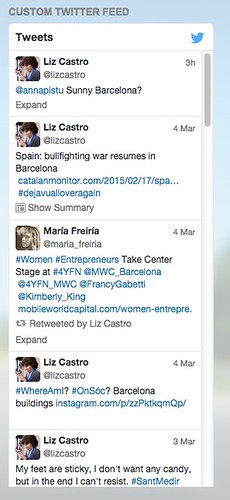
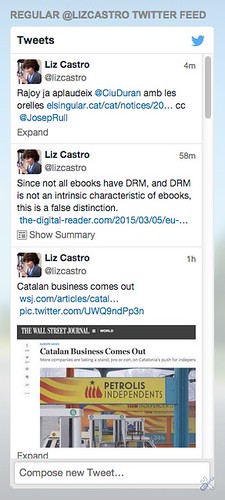
To sum up, let's look at that Twitter feed we created, with tweets from me, about Barcelona, not including FCBarcelona, and only in English (on the left) compared with my standard Twitter feed on the right:

results regular_feed

Thursday, September 12, 2013

About croquetes, Twitter, and the Catalan Way

Photo Sep 11, 4 32 52 PM

Yesterday's Catalan Way—Catalonia's 250 mile long joining of hands in support of Catalan independence from Spain—would not be the first movement to question Twitter's algorithms for choosing trending topics. But I'm sure it's the first one to respond with #croquetes!

Yesterday, Twitter buzzed with reports, videos, and photos from the #CatalanWay, which in Catalan is called the "Via Catalana". Today, it is newspapers all over the world, from the New York Times, Washington Post, Wall Street Journal, Los Angeles Times in the US, to the Guardian, Telegraph, Independent in the UK to Der Spiegel, Die Welt, Berliner Zeitung in Germany, and so on and so on. VilaWeb has a good list.

But Twitter stubbornly refused to register #ViaCatalana, the hashtag marking most of the posts, as trending. During a radio show on RAC1, Jordi Basté explained that Twitter had told them that 1000 people had to be talking about a particular topic in order for it to 'trend', but that it was important that that topic not have trended the previous day. Half in gest, he said, why don't we test that theory with "#croquetes" [a very typical and common kind of special leftovers in Catalonia, generally meat mixed with bechamel sauce and fried, quite delicious].

Within minutes, everyone was tweeting #croquetes, and sure enough Twitter quickly listed it as a trending topic. In fact, it's still trending this morning.

(20) Twitter / Search - catalanway

While some talked of conspiracy and showed that #viacatalana was being heavily used across social networks, others explained Twitter's system for designating trending topics.

My opinion is that whatever Twitter's system is, it does not work. There is absolutely no reason that such an event, closely followed by the world media, front page on Wikipedia, and tweeted by hundreds of thousands of people would fail to 'trend'. Twitter needs to revise its trending topic algorithm, so that we don't have to resort to silly tricks like tweeting about yummy food. And it's true that, totally coincidentally, I had #croquetes for dinner last night!

Monday, July 15, 2013

Playmobil triggers, or why I spend so much time on Twitter

Last night, my daughter decided to recreate our entire kitchen in Playmobil. The counters and kitchen furniture, a dog and three cats, a bowl in the island and silverware in the drawer just where we keep ours, but also dishes in the sink, overflowing compost, father making dinner, son playing soccer, and me on Twitter. I'm biased but it's quite brilliant.

Liz (and her phone) in Playmobil

My kids tease me about my Twitter addiction and at dinner, after I tweeted the tomato picture they also accused me of being one of those “food tweeters” (gasp!), clearly not a good thing. But subscribing to Tim O'Reilly's tenet that ambient intimacy is one of Twitter's keystones, I forged ahead undaunted, and tweeted the part of the Playmobil portrait that was of me and my coffee and my phone.

Which is when Twitter did its magic. My Twitter friend Melissa Techman favorited it and asked if she could use it for a Thimble mashup she was doing with her teens. Melissa is a librarian in Virginia (Maryland?) who is always working on amazing ways to get kids thinking and working on books and technology. Though we haven't (yet) met in person, we've been following each other for a year or so, and seem to continually find interests in common and ways to bounce ideas of each other. She organized an online workshop last year for which she invited me to do a short presentation on ebook production. I'm excited to see what else we can collaborate on in the future.

Melissa and Thimble

Meanwhile my daughter wanted to know what a Thimble was, so I asked Melissa, and she pointed me to the website. And it turns out it's a way of creating web pages—I haven't figured out the remixing part yet—and so my daughter and I spent the next hour or so writing HTML. It's hard for me to quantify what a treat it is to be able to share my knowledge with my kids. They know almost everything already (!) so it's pretty rare that they let me teach them anything. But if someone else suggests it... well, thank you, Melissa!

After my daughter went to bed, I spent a little while following some of Melissa's tweets about #clmooc. I keep bumping into MOOCs and I know I should know more about them and that I will love them when I get there, but I haven't had a moment to look more closely. But just reading those MOOC-related tweets is what gives me hope about the world. There are so many people working together, sharing knowledge, learning cool things, inventing, making.

It didn't stop there. This morning I found that Kevin Hodgson had started to follow me. It caught my eye that he lives in Western Mass, but as I wandered about the last few tweets in his timeline, I found interesting clues to just what #clmooc is up to, and also found a great list of Techno Skills, written by Kevin Kelley, which I shared with my Catalan tweeps. Hopefully, one of them will be inspired to translate the list into Catalan so it can be shared further.

One of Kevin Hodgson's links also got me thinking about Minecraft which helped me realize I should probably not freak out quite so much about how much time dear daughter spends with it. Indeed, encourage her even. And so it goes full circle, while leaving and sharing a little bit at every stop.

Bonus. This is not the first time I've been depicted in toys. I met another Twitter friend, Maia Weinstock after reading in her bio that she makes "science and music personalities come to life in LEGO". (I love Lego.) Then I noticed she retweeted my Catalan stuff, and it turns out she's part Catalan too! We met in person for the first time for a Sant Jordi event at Harvard University in April, when she presented me with a Liz Castro minifig. Totally honored!

Thursday, January 24, 2013

We're not the media if we depend on Google (or Amazon)

Update: 25 January 2013. This morning when I typed Catalonia into the Google Search box, and then clicked the News tab, all of the stories about the Declaration of Sovereignty were hidden behind an even smaller "+ Show more" link below the generic AP post carried by the Huffington Post. If I click on "All 88 news sources" I get this complete fail:

Google can't find Catalonia

Maybe there is a conspiracy!

I've also changed the headline of this article from "We're not the media if we don't appear on Google (or Amazon)" to "We're not the media if we depend on Google (or Amazon)". We need an alternative.


Yesterday there was a news story I was particularly interested in. But searching for it on the internets made me rethink a lot of assumptions about the idea that "we are the media". I first heard that expression used by Amanda Palmer, a singer/songwriter/artist who ran an incredibly successful crowdsourcing campaign a few months ago—raising over $1 million—to fund a new record. One of her most intoxicating claims was that she didn't need to sign with a studio, and she didn't need to follow a studio's rules and directives. With the support of individual people—me included—she could put out her record and go on tour. In short, she and "we are the media".

I've been writing books for the last 20 or so years with the same idea in mind. My HTML books helped people realize that they could publish their ideas, their writings, their photographs, their lives without having to ask for anyone's permission. At first, I published a gallery of these brand new websites, and I loved going through them and seeing democracy in action: all these people sharing their thoughts with the world, with no gatekeepers to stand in the way.

The gallery quick grew to multiple pages of lists, and the web to billions, and so I left the job of cataloging these new creations to the brand new Google. I'll get to that in a moment.

A few years ago, when I discovered EPUB, I had the same feeling of democratic excitement: here was a technology that could help people publish and otherwise share their writings. We humans yearn to share our stories with others. EPUB, an open format, facilitates such an interchange.

But yesterday, it really hit home how far we are from complete democracy of content. And that's because though we may have the technology and even free tools for creating webpages and ebooks, there are massive economic and political powers that stand between us and our readers. We cannot ignore them. Let me show you yesterday's example.

First, let me admit that the word I typed into Google was "Catalonia". But the ramifications go way beyond this particular news item. So, please bear with me as I use my favorite example to illustrate something much larger.

When I type in "Catalonia", Google says there are 83 news items. When I ask Google to show me "all 83 news sources", it gives me a list of only 16. You can try this at home.

Down at the bottom of the page, Google has a little disclaimer that says it omits some entries that are "very similar to those already displayed". And this is probably not the right time to discuss wire services and the sad fact that a single mediocre story with no byline about a small, new far away country might be reproduced verbatim, with no fact chacking, in 80 or so American newspapers. But I digress. But if you click "repeat the search with omitted results included" Google still only displays 25 items. There is no way to see all 83.

Google's "Full Coverage"

I would very much like to know which other 58 news sources are reporting on my topic. Why won't Google show me? And how does it decide which 25 items to show? And isn't it a problem that I am necessarily limited by Google's criteria?

Do I think there's a conspiracy to keep the other 58 news sources from being revealed? Probably not, but regardless, it bothers me quite a bit that there's no way to get to them. Like it or not, we are not the media, if we cannot be Googled.

And it doesn't stop there. Amazon recently decided that authors of the same genre books cannot review other authors' books. Amazon became successful because of its review system. I am not the only person who used to look at Amazon reviews in order to decide which book to find from the library. Amazon's reviews were an amazing crowdsourcing adventure, now run amok by enterprising and back-stabbing authors on the one hand, and Amazon wanting to watch the gates, on the other.

And don't even get me started on Amazon search. How much publisher money is behind Amazon's search results? I have no idea, but I'm guessing it's not insignificant. We are not the media if we don't come up on Amazon.

The Amazon review issue brings up yet another aspect of this whole story, which I touched on in an essay titled "If you know it already, don't tell". The basic gist of that article is that we believe people more when we don't think they have an axe to grind, even if, ironically, as in the case I describe, the person isn't particularly knowledgeable at all about the topic.

This is the same conundrum that Amazon's new policy throws at us, and that Porter Anderson confronted in his recent post in On the Ether. Where is the line between enough knowledge about a subject in order to give a reasoned opinion and so much knowledge about the subject that your opinion is biased? In this day and age when every one's past opinions are documented publicly, can there even be unbiased opinions? I think not. I believe that the important thing is to know what the opinion is, so we can use that information to assess the validity of the opinion. Suppressing all the opinions that Amazon has decided fall into a particular category of user solves nothing.

In these heady times in which self-publishers, and the web designers that came before them, are gleeful with democratic information sharing, we must be absolutely aware that the gatekeepers have simply moved the gates. Whereas in earlier eras we couldn't even publish without their help, now we can publish, only to find our sites and books hidden in a sea of information. Even if your book or website is in there, if Google or Amazon or whatever search product of the moment won't bring it up, it's as if it weren't there.

All is not lost. Twitter, and to some degree Facebook as well, are still amazingly democratic, allowing us to connect directly with kindred spirits all over the world. While we can't forget that social media still generates only a fraction of web traffic (on the order of 5-6%), I think its influence goes far beyond those numbers, if only in its ability to connect people and movements. But will they last? And Kickstarter (and for example, the Catalan crowdsourcing site Verkami) are great at helping us harness the power of hundreds (or thousands if you're Amanda Palmer) to offer alternatives to these gatekeepers or, when need be, attract their attention. Technology-wise, the use of accurate metadata can also help make a book or website "findable".

Ironically, it is the very birth of Google that gives me hope. Way back then, Altavista was the most popular search engine, and I remember being increasingly frustrated with its ads, its promoted links, and the seemingly deliberate obstacles that it placed between me and what I was looking for. This clean, lithe little ad-free Google came along and all of a sudden we could find things again. It felt like the whole world changed over to this little search engine that actually worked in a matter of weeks. Perhaps it's time for some new disruption.

And while we wait (or develop) the tools to maintain our democratic web, we must be careful to be aware that right now there is no unbiased opinion, and no unbiased search.


Friday, November 2, 2012

And iBooks needs iOS6 for sharing, too

One of the new features added to iBooks 3 that I wanted to try was sharing bits of a book via Twitter. But when I tried it, it didn't work. I thought maybe it only worked with purchased books, or DRM'd books, or some other kind of book I didn't have. Nope, the problem once again, as with MathML, hinted at by Baldur Bjarnason, was that I was still resisting upgrading to iOS6.

Now that I've got iBooks 3 and iOS6, sharing bits of books via Twitter (and Facebook, Mail, or Message) works swimmingly. Start by selecting the text you want to share.

Once the text is selected you can either highlight it or share it without highlighting (by clicking Share at the far right). I want to highlight first, so I click Highlight.

Sharing with iBooks3 - Select

Once the text is highlighted, iBooks offers me additional options. I can change the color of the highlight, remove the highlight, add a note, or share—with the Away arrow—which I now click.

Highlighted - Share

Once you click the Away button, iBooks offers you a choice of sharing methods. I'm going to use Twitter.

Sharing with iBooks - Twitter

Then iBooks will show you the selection (or a piece of it if it doesn't fit within Twitter's 140 character limit), along with the iTunes link to the book, if it's a purchased book. You can share from sideloaded (e.g., non-purchased books) but iBooks won't be able to link to them in the iBookstore.

Sharing - selection

You can add your own comments (as long as they fit). And, of course, you could edit or remove the shared bit or the link as well.

Sharing - comments

Finally, click the Send button.

If you've highlighted before sharing, that's what you'll be left with.

Sharing - highlighted

The tweet becomes part of your regular Twitter stream, as if you had used your regular Twitter client. This was just an example, and I didn't expect a response, but Twitter is like that, and someone was listening:

Tweeting iBooks

Indeed, the more I think about it, the more I like the idea of tweeting interesting parts of books that I'm reading. I imagine I'd do it less with fiction than with non-fiction, but I'll let you know.

Twitter is limited to 140 characters, but I was curious how much iBooks would let me email. I made the text as small as I could, and then selected two full pages of text, and emailed it to myself.

Apple automatically clips the selection to 199 words, and then adds the cover, author, title, publisher, publication date, and copyright notice, along with a link to the book in the iBookstore.

Sharing with iBooks 3 via email

Also notice that the excerpt is centered, and images and all formatting instructions (including bulleted lists) are stripped. For example, if I select a section of my Read Aloud EPUB book as shown here:

Sharing images and formatting

The resulting email looks pretty dreadful:

Sharing images and formatting (or not)

I also tried copying text and pasting it into the Notes app, but that excerpt, too, was clipped to 199 words, and the formatting and images were removed.

I was able to copy successive paragraphs out of books and thus cumulatively copy out more than 199 words. Given that they feel compelled to limit copying, this at least is a sort of reasonable compromise: Keep readers from simply copying the entire book out, but let them share as much as they want in bits and pieces. Note that iBooks limits how much can be copied whether the book is DRM protected or not.

Finally, I also noticed that no highlighting or sharing is allowed in fixed layout books. I don't know why not. Seems like a recipe book, which might well be in fixed layout, would be just the place you want to add notes and perhaps comment on what you're making on Twitter.

iBooks3 sharing fxl

Tuesday, September 11, 2012

Translating Twitter and Catalonia's March for Independence

Update: Twitter has reinstated my account, saying that translating tweets is not a violation of their TOS. Thanks to all who helped!

TweetToday, hundreds of thousands, probably millions of people are marching on Barcelona to demand Independence from Spain and a new Independent State in Europe. And they're all tweeting about it, using #11s2012 and sometimes #FreedomForCatalonia.

The thing is, they're mostly tweeting in Catalan. And since this a huge issue that affects all of Europe and perhaps the world, I thought it would be helpful to translate as many of those tweets as I can into English.

Not wanting to bombard my kind and comprehensive loyal followers of my regular Twitter, who mostly are interested in my tweets about EPUB, I created a new account, @11s2012EN, and I carefully added my image and information so that it was not anonymous.

I then searched for the hashtag #11s2012 in tweets that did not contain #en. There are thousands! And I've been translating them as quickly, neutrally, and faithfully as I can. I change the RT to MT to indicate that I have "modified" the tweet (by translating it into English). Sometimes I have had to abbreviate, or remove extra hashtags in order to make everything fit, but I try to keep it as close to the original as possible.

So this:

Catalan Tweet

became this (which I can't show on Twitter, because they've suspended the account):

Translated tweet

In fact, many of the people whose tweets I've translated have then retweeted the translation, themselves.

But Twitter thinks I'm spamming by sending @ replies to people I don't know. They don't realize that I'm translating. And they've suspended my account.

So, Twitter, can you clarify? Is translating others' tweets really spam? What if they don't mind? What if they *want* me to do it? Is there another way you'd prefer I do it? Automated translation just doesn't cut it.

This is a multilingual world, and some of us who know more languages can help the rest of us who don't. You should be facilitating communication, not hindering it.

Please restore my account so that I can help people understand what is going on in Catalonia today. It is truly monumental.

And if you'd like info on today's march, try:

The Guardian: Barcelona braces for million-strong march for Catalan independence

Wikipedia: 2012 Catalan March for Independence

Help Catalonia

Or at http://www.11s2012.cat/global, where we're collecting all tweets with #11s2012 and #en in them. (I think this use of two hashtags is pretty revolutionary in itself!)

Or follow my regular account on Twitter, I try to keep the Catalan stuff to a minimum, but I'm not very good at it :)

Wednesday, May 23, 2012

Pepcon 2012

I'm writing this on the plane on my way home from Pepcon 2012. I'm tired and annoyed with the TSA, but even they cant take away my appreciation for having gone. As much as I love and value the connections and communication that happens online, there's something about meeting people in person that somehow makes it all real.

I wanted to write a little about what it was like so those who couldn't go could get a feel for it.

I didn't get to Pepcon until almost 3pm on Monday due to some prior commitments. But there were some sessions still going on when I got there, and I listened to part of Mike Rankin's top ten Long document tips and then a bit of Bob Levine and Keith Gilbert's presentation on DPS. One of the hardest parts of most conferences for me is wanting to listen to multiple presentations at once. My solution is to wander from one to the next, but it's imperfect at best.

Let me confess that I don't know a thing about DPS, but my first impressions aren't that great. It feels like a dead end to me, and I personally can't stand subscription programs; I don't want to be locked in month after month, I want to own. And it's all images, even the text?? No. I want standards so that my content doesn't get lost under proprietary formats. I don't want all my eggs in anyone else's basket.

After the sessions I took part in the first of two meetings with the senior InDesign engineers from Adobe. I've been on the InDesign beta team for a while so their names were familiar, but this was the first time I had met any of them in person. I was totally impressed. They asked us what we wanted (in terms of InDesign support for EPUB) and then carefully listened as we debated the merits of different solutions and the problems of various strategies. They didn't make any promises and they didn't make us sign any NDA forms, they mostly just listened and gave us feedback about our complaints.

One of my big complaints was that the CSS that InDesign generates has too many default values, and doesn't take advantage of CSS' power of inheritance (the cascade). It's tricky, because you can have an unending hierarchy of styles based on other styles in InDesign but the most obvious way to translate that to CSS involves using multiple classes, which are unfortunately not supported by all ereaders. There is limited cascade without multiple classes though there is the body, the p elements and then individual classes.

Throughout the course of the two meetings (almost four hours) we talked about a lot of issues. We didn't come to any firm conclusions and they made no promises but I think the important bit was helping them talk with people who actually use the tool to make EPUB files—probably Ron Bilodeau and Colleen Cunningham were more useful in this regard than I was.

And I don't mean that in a flippant way. In my own personal experience, it's a challenge to both write about how to create EPUB and actually create EPUB files. I imagine that it's even harder writing software that creates EPUB files and actually creating EPUB files. I'll come back to this point.

After the meeting with Adobe, I went to the Pepcon Ignite session. My favorites were the ones by MarisaKC and by Kelly Vaughn, whose presentation on creating crazy shapes with various weights and kinds of strokes reminded me a bit of my own exhaustive report on the possibilities of iPhoto.

You'll notice that I haven't mentioned food yet. I went up to my room and ate some of the lovely fruit that Anne Marie and David had left for me. but I didn't go out to dinner because I still wasn't done with my presentation despite my promises to myself not to leave it to the last minute. Having to stand up in front of people and say something relevant is a really good way of proving the difference between having an idea and actually having a presentation. I knew what I wanted to say, I knew where I wanted to put the emphasis, but when I started to practice out loud, I realized (yet again) how much work it is to put those ideas into a shape that makes sense to other people. Easy is hard, and all that.

I didn't get to sleep until 11:30pm local time, which was 2:30am in my head, and I had been up since 3am the night before because I had left on an early flight. Note to self: really, really finish your presentation before you go to your next speaking engagement.

I woke up at 5am, thanks to a call from my non-time-zone-aware-daughter, but then took advantage of the time to really finish my talks, and practice them all the way through.

During the morning session, while hearing the brilliant ID scripter Kris Coppieters, admit that he “isn't an InDesign user”, and then watch several more presenters describe features I've never used and sometimes never heard of, the difference of using a program and creating the program (or teaching others how to use it) became even more clear. It's really hard to do both.

I think of the morning sessions, it was Gabriel Powell's that was the most helpful in terms of EPUB stuff: “Preparing Images for ePub/eBook”.

At lunch, I had a nice chat with Ron Bilodeau and Felipe Santos, the former from O'Reilly in Cambridge, and the latter from Brazil. These are the moments that make a conference special: catching up with people face to face that you might know online (like Ron), and learning different perspectives and needs from people you're meeting for the first time (like Felipe).

At 1:30, I gave my first talk, on Enhanced Ebooks. I started by talking about what sorts of books are encompassed by that term, and then talked about how to embed audio and video in an EPUB file with InDesign, using the techniques shown in the blog post that I published that same day. I was pretty jazzed to be able to explain to these InDesign-centric and perhaps code-cautious listeners that they could create enhanced ebooks without cracking their EPUB files and looking at the dreaded HTML.

Then Matthew Diener joined me to explain what EPUB 3 has in store, wisely showing some nice examples on both Azardi and Readium. Then I gave a more nuts and bolts look at exactly what EPUB3 code looks like. It's not that different from EPUB2, you'll be happy to hear. There were many fewer listeners in the EPUB3 talk than the Enhanced Ebooks presentation. I think people are wary of future technologies that are not yet implemented. But as I mentioned yesterday, EPUB3 is now supported by the iBookstore, and Apple is using it in standard ways to provide a better user experience. It's time to make the move.

After my talks, we had another two hour meeting with the InDesign crew, in which we discussed indexes at some length. One of the issues we argued about was how to label references to content. That is, if you go look up EPUB3 in the back of a print book, you might see something like:

EPUB3 12, 45-67, 78, 92

In an ebook, of course, there are no discrete pages, and so at first glance, you might be inclined to do away with those references altogether and use something like:

EPUB3 1, 2, 3, 4

But I argued that even though the page numbers themselves might be an artificial construct, they still give us information about what we might find there, that is lost in the replacement solution. In the example above, I might expect a short introductory mention on "page 12", a more thorough treatment on "pages 46-78", and less introductory, but still short mentions on "78" and "92". How do we convey that information without the actual page numbers? The short answer is, we don't know yet.

Finally, it was time for dinner. I was looking forward to meeting EPUB coder extraordinaire Rick Gordon for the first time, and had put out a call on Twitter to see if anyone wanted to join us. It was a really interesting bunch in the end (about 10 of us) who made it to the Jazz Bistro Les Joulins, just down the street from the hotel. The food was good, and the conversation interesting, and heavy into code :)

Not quite done, in the morning, I spent an hour at the Meet the Author's table with Steve Werner, InDesign expert. I'm not sure people really knew we were there, but I got to talk to a few people who wandered over.

The last thing on my agenda was to talk to Kris Coppieters and see some of his amazing scripts in action. He kindly came out to give ma demo and I was totally enthralled. While I had originally talked to him about a script that converts blogs to InDesign documents, I was most interested in his CSS Geometry which spits out the coordinates of the text blocks in an InDesign document and might be very useful in generating Fixed Layout ebooks from InDesign.

And I did get to see a cablecar!

San Francisco Cablecar

Many thanks to Anne Marie Concepcion and David Blatner for inviting me, and in general for organizing the conference and getting so many interesting people together! (And thanks to Matthew, whose nicest tweet ever is still making my day.)
Wednesday, May 9, 2012

Announcing and Denouncing Spanish Hate Speech towards Catalans

I came across a new Catalan website that has been documenting a very disturbing trend of Spanish hate speech towards Catalans. The site, Apuntem.cat (which means, We take note), retweets and records the hate speech so that people understand what Catalans have to deal with on a daily basis (and perhaps some of the reasons behind Catalonia's independence movement).

Honestly, I find Apuntem's Twitter stream really difficult to read. The people they retweet are really vile. But I agree with Apuntem's basic premise, that it's important to shine the light on them. Indeed, it seems that many of the posters have deleted their Tweets after Apuntem outed them, for shame or embarrassment, who can say.

Here's a sampling of commentaries from back in March about some kids in a school in a little town called Ripoll who sung the Portuguese song "Ai se eu te pego" in Catalan. You can find the original Spanish versions collected here.

"Infinite contempt upon hearing the kids singing Michel Teló's song... IN CATALAN #CastillianWhereAreYou"

"Disgusting kids... "renew, renew" over and over again, and on top of it all, in Catalan."

"Shameful those 6 year olds who were on channel 4, that at that young age, they're already speaking Catalan."

"They bring out some disgusting kids singing in Catalan... this is Spain for God's sake!"

"Catalans make me sick, children, parents, old people... all of them, hope they die."

"Those kids who came out to sing to Guardiola in Catalan should have been drowned upon birth. There would be less garbage."

"It's like a kick in the mouth hearing those kids sing in Catalan. That's what you get on sports channel 4."

"What a shame that they teach those kids to speak Catalan at such a young age. We're in Spain!"


That was about little kids. When they're talking about Pep Guardiola, FC Barcelona's coach for the last four years who just retired and who gave his farewell speech in Catalan, it gets worse. (Original Spanish hate tweets.)

"Pep, hope you get it in the ass, don't speak Catalan, you son of a bitch."

"What a fucking obsession with speaking Catalan, god damnit."

"Go ahead, speak in Catalan, but I'll shit and stomp on your ancestors Guardiola, die.

"Guardiola speaking in Catalan, he should be ashamed!!!! CLOWN! YOU'RE A CLOWN"

"Jail for Guardiola for speaking Catalan in stadium full of Spaniards."

"What a shithead disgusting Catalan!!! Speak in Spanish you fucker. #disgustingcatalans"

"Pep, speak in Spanish, you Catalan shithead."

"Son of a bitch Pep speaking in Catalan... Speak Spanish you asshole"

"What a lack of respect! Speaking in Catalan? And what about the people who don't understand it? That's his humbleness. Fucking Catalonia."


And it goes on and on. And I didn't even translate the ones that suggest bombing the Catalan football stadium. They should be ashamed. And everyone who lets such hate speech go by without reproach shares the blame.

Indeed, it seems that some are ashamed, and take down their tweets. They should never post them to begin with.

Thursday, March 1, 2012

Asymmetry on Twitter

I received an unpleasant email the other day from someone who had bought one of my books, followed me on Twitter, and then realized I wasn't following them back. They then unfollowed me, and when I sent word about my new subscription, they wrote me back to tell me that following readers of my books was just common courtesy, which I clearly lacked.

I've let it stew in my head for a few days, and though I'm sorry I made that person feel bad, the truth is I think asymmetry—the fact that you don't have to follow back those who follow you—is one of Twitter's most important features. Let me explain.

Twitter is my social media tool of choice, both for learning and for sharing. I consider the 140 character limit an absolutely brilliant and sublime innovation and I love how it trains us all to be editors, peeling away the layers of excess. I try to follow the tenets described in Tim O'Reilly and Sarah Milstein's excellent and newly updated The Twitter Book, especially that of adding value to the conversation. Still, I consider myself a difficult person to follow on Twitter, since my tweets are divided between two very distinct topics: ebook production and Catalonia, which have a limited amount of overlap. My followers generally have to bear a fair number of tweets on the other topic, often in another language. And sometimes I tweet a lot.

In short, I'll understand if you don't follow me. I know how it is. Which leads me to the second half of my Twitter life: the 500 or so people that I currently follow. You are all amazing. I learn so much from you. And unfortunately, I can't read half of what you write. Of course, I can't read even the tiniest percentage of what's on the internet, so I figure I'm doing OK with half of your helpfully filtered stream. Thank you.

But still, I worry about the other gazillion people, my disgruntled reader among them, that I don't follow. Not because I may be hurting their feelings, but rather because I'm missing out on what they might share. I'm sure I should be following some of them, but how to know? Once in a while, I look at people's profiles, and if something catches my eye, I might check out their latest Twitter stream, but as the list of people who I follow (and my to-do list!) grow, I get more and more reluctant to add any more information to my already overflowing banks. More often, I follow people that I have conversations with, who ask interesting questions, offer interesting links or insights, or well, who can help Catalonia become independent.

So I like Twitter's asymmetry. I follow lots of people who don't follow me, and lots of people follow me that I don't follow. I am honored when someone decides I'm worth following, but rarely insulted when they don't. Being able to follow anyone without the obligation that they follow me back has allowed me to connect to a much wider group of people than any compulsory following ever would have. I can follow Roger Ebert, Elisenda Paluzie, Neil Gaiman, and Miquel Calçada without worry of imposing or being a fangirl. I believe asymmetry encourages authenticity and also allows a more gradual connection which may well end up in mutual following.


For the record, I do have a Google+ account or page, but clearly haven't been there enough to even know what it's called. I'm on LinkedIn only because I wanted to be able to access the ebook discussion groups, but honestly, I need Twitter's 140 character limit in all parts of my life, so I barely ever go there. Plus, LinkedIn always seems to know more about me than I told them and generally gives me the creeps. If I don't follow you there, or talk to you there, just talk to me on Twitter.

And though I am on Facebook, I mostly use it for personal stuff, though, truth be told, my Facebook friends get a fair bit of information about Catalonia too. 


Saturday, September 17, 2011

Dialing without mittens (Twitter in Catalan #twitterencatala)

We want Twitter translated into Catalan, image by Vilaweb.catWe Americans mostly speak English (and exclusively English) and are so lucky to have so much technology in our own language. Imagine, for a minute, if we didn't. If you had to navigate in French or in Japanese. It would feel like dialing a telephone with mittens on.

Catalans dial with mittens every day because Twitter's interface is not available in Catalan. Twitter announced last week the translation into five new languages with plans for six more, none of which was Catalan. There is no logical reason for this. Catalan has more speakers than several of the languages proposed and has a vibrant, active online community. Catalan, for example, is the 13th most used language on Wikipedia with over 350,000 articles published in that language, many more than say, Wikipedia articles in Korean, Malay, Danish, or Hungarian, all of which have or are slated to have Twitter versions.

In fact Dick Costolo, Twitter's CEO, promised last year that Twitter would soon be found in Catalan. And yet the months pass by, and it doesn't happen.

Since I joined Twitter a couple of years ago, it has turned into one of the most important tools on my computer. It helps me learn new technologies, keep up with the ones I already know something about, connect with colleagues all over the world, and confirm if what I just felt really was an earthquake.

One of the best features of Twitter is the way it conveys what Tim O'Reilly and Sarah Milstein call “ambient intimacy” in their excellent work, The Twitter Book. Ambient intimacy is the connection that you feel for people who you follow by dint of the personal details that they add to their Twitter feeds.

And despite the luddite view that knowing what someone had for lunch is just too much information, knowing that they barbecue organic vegetables or can their own strawberry jam really does give context to the more professional information they might be sharing. In the same way that the real life examples in my books make the technical information more tangible, and thus more intelligible, knowing something about the people we are talking to online makes the information they share all the more valuable, and frankly, more interesting.

Which is a very long explanation of why I tweet so much about Catalonia and Barcelona and the Catalan language and Catalan politics and human castle building and calçots.

Albert Cuesta, a journalist in Catalonia, started a petition to ask Twitter to provide its interface in Catalan. I ask you to please sign that petition: http://act.ly/ns He's not even asking Twitter to do the translation, just to allow that the translation be made. And then please retweet and spread the word.

Today at 2pm EDT, 11am PDT, and 8pm local time in Barcelona (CET), we will tweet in unison our request to translate Twitter into Catalan. Please join us by adding #twitterencatala @jack @biz @dickc to your tweets.

Catalans, too, deserve the right to use this powerful tool in their own language; to dial without mittens.

Wednesday, September 23, 2009

Follow me on Twitter badge

So, I spent way too much time wandering about looking for one of those Twitter badges that say "Follow me on Twitter". And then I looked inside the code generated by one (which was really ugly!) and all it is is a link to one's Twitter account. Hey, I can do that.

So, if you want to add a Follow me on Twitter badge to your site, just use code something like this:

<a href="http://www.twitter.com/TwitterAccount">Follow me on Twitter</a>

(And if you want to add it to your Blogger blog, just go to Layout | Page Elements, and then add an HTML/JavaScript gadget. Paste the link into the Content box and you're all set.)

More of my books